A promotion does not reveal a person’s permanent limit. It places that person at the beginning of a new learning curve.
I saw a LinkedIn post using the Peter Principle to explain why an elite salesperson should not be promoted to sales manager.
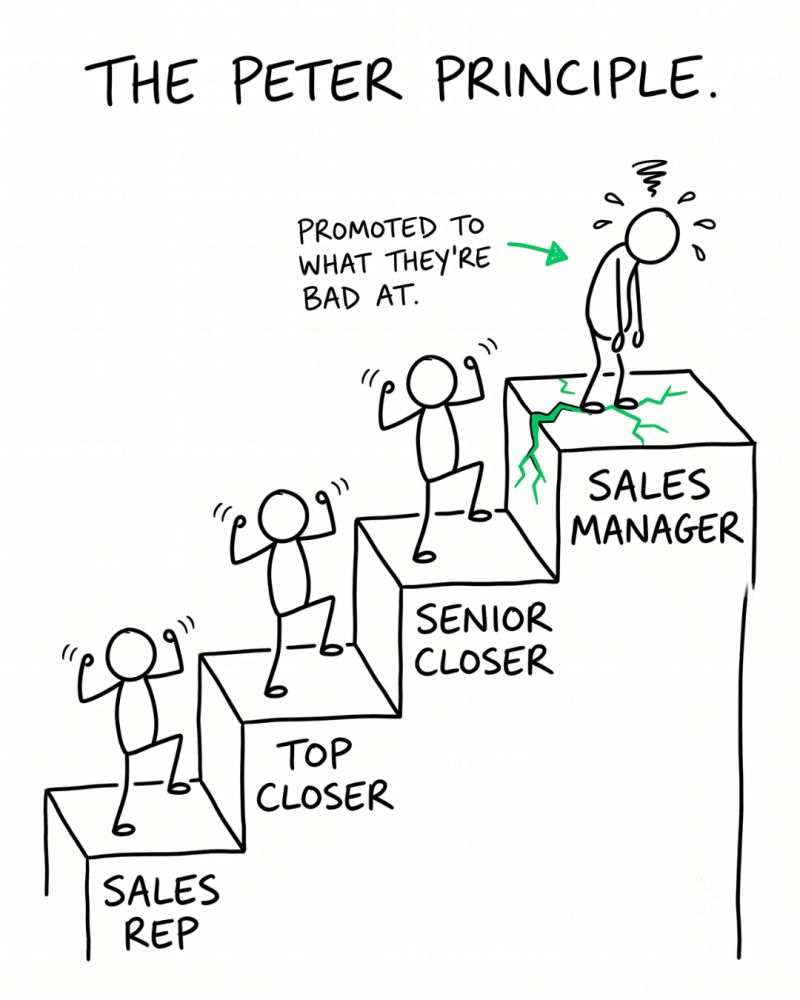
The warning sounds sensible.
A person may know how to find prospects, handle objections, and close difficult deals. That does not mean the person knows how to coach a struggling seller, lead a pipeline review, resolve conflict, or hold someone accountable.
Selling and managing salespeople are different jobs.
But “do not promote your best salesperson” does not solve the problem. It replaces one bad assumption with another.
The first assumption says:
A great salesperson will become a great sales manager.
The second says:
A great salesperson will probably become an incompetent sales manager.
Neither conclusion is supported by the person’s sales record alone.
What the Peter Principle actually warns us about
Laurence J. Peter and Raymond Hull introduced the Peter Principle as satire. Its most famous claim was that people in a hierarchy tend to rise to their “level of incompetence.”
The pattern is easy to recognize.
Someone performs well, so the organization grants a promotion. The person performs well again and receives another promotion. This continues until the person reaches a job that requires abilities they do not possess. Because poor performance no longer earns another promotion, the person remains in that role.
Behind the exaggeration is a useful warning:
Competence in one job does not prove competence in the next.
A great software developer may not know how to lead a development team. An excellent nurse may struggle to manage a hospital unit. A high-performing machine operator may not know how to give direction to twenty other operators.
Organizations make a mistake when they treat promotion as a reward for past performance without examining the work required in the new role.
But that is where the useful warning should end.
The Peter Principle becomes misleading when we treat it as a law of human potential.
People are not finished products
The principle assumes that a new position eventually reveals the person’s fixed limit. Once the employee reaches that limit, there they remain: promoted beyond their competence and unable to recover.
But people are not finished products.
They learn. They adjust. They build abilities they did not possess before. New situations can also reveal strengths that their previous jobs never required.
I have known people who were not exceptional salespeople but became excellent sales managers.
They may not have enjoyed prospecting. They may not have been the strongest closers in the room. But they could listen closely, recognize why someone was struggling, explain an idea clearly, organize the work, and help another salesperson regain confidence.
Their previous role concealed those strengths. The promotion gave those strengths room to matter.
The reverse can happen too. An elite salesperson may struggle as a manager. The person knows how to win a customer but not how to help ten other people do the same. Instead of coaching, the manager takes over. Instead of building judgment, the manager gives answers. Instead of developing the team, the manager becomes the team’s most expensive salesperson.
Past performance cannot settle the promotion question in either direction.
A person’s present job shows us what that person has done under one set of conditions. It does not show us everything the person can do, what other strengths may appear, or how quickly the person can learn.
New does not mean incompetent
Imagine that Maria has just been promoted to sales manager.
During her first pipeline review, she asks for updates but does not challenge weak assumptions. She accepts promises that deals will close “soon.” The meeting ends without clear next moves.
The following week, several expected sales fail to materialize.
Has Maria reached her level of incompetence?
Perhaps.
But there are other explanations.
Maria may never have seen a good pipeline review. No one may have shown her what questions a manager should ask, what evidence to examine, or how to turn a hopeful forecast into specific action. Her manager may have congratulated her on the promotion, handed her the targets, and expected her to work everything out.
Maria is struggling. That much is visible.
But struggling in a new role is not proof that she has reached a permanent limit. It may mean that she is standing at the bottom of a new learning curve.
We should not hide poor performance behind endless patience. The work still has to move. Results still matter.
But leaders must distinguish among three different conditions:
- A person who has not yet learned the new role.
- A person who can learn it with practice and support.
- A person whose abilities, interests, or choices do not fit the role.
Calling all three “incompetence” prevents the organization from learning what is actually happening.
Promotion is not preparation
The larger failure often begins before the employee struggles.
Organizations spend years teaching someone to perform one job. Then they announce a promotion on Friday and expect competence in a different job by Monday.
The title changes. The scorecard changes. The relationships change. But little else does.
No one explains that the new manager must stop winning through personal effort and begin winning through other people. No one identifies the recurring moments that will now define the work: giving direction, delegating responsibility, coaching performance, leading meetings, resolving friction, and making decisions at the right level.
The organization mistakes promotion for preparation.
Then, when the new manager struggles, someone invokes the Peter Principle.
Perhaps the person has not reached a permanent ceiling. Perhaps the organization has simply placed the person in a new game without making that game clear.
This is why leadership development must do more than teach a list of competencies. In Build Leaders Who Move Work, leadership becomes visible in recurring moments. A leader makes the expected win clearer, helps people decide, builds ownership, removes avoidable delays, and enables work to move without taking everything over.
Those abilities can be observed. They can also be practised.
Let people play parts of the next role
Organizations do not have to wait until after a promotion to discover whether someone can manage.
Give potential candidates small but real moments from the next role.
Ask the elite salesperson to coach a colleague who is losing deals after the first meeting. Let the candidate lead one pipeline review. Ask them to diagnose why follow-ups are not happening. Let them run a role-play, lead a short improvement effort, or help the team prepare for a difficult client conversation.
Do not judge the person from one attempt.
Observe what happens. Give feedback. Let the candidate try again.
You are looking for more than a polished performance. Watch for evidence of how the person thinks and learns:
- Can the candidate make the expected result clear?
- Do they ask before giving advice?
- Can they find the real obstacle?
- Do they help someone think instead of supplying every answer?
- Can they give useful feedback without taking over?
- Do they make decisions when needed?
- Can they build ownership and still provide support?
- Does their next attempt improve after feedback?
These moments reveal much more than the person’s sales ranking.
The question is not simply, “Can this person do the manager’s job today?”
A better question is:
Can this person learn to produce results through other people, and what evidence have we seen?
Use real work as the practice field
Many organizations try to identify leadership potential through interviews, personality tests, and opinions from senior managers. These inputs may help, but they remain predictions.
Real work produces stronger evidence.
A person who says, “I enjoy developing people,” may behave differently when a colleague ignores feedback for the third time. Someone who appears quiet during an interview may become remarkably clear when asked to diagnose an actual customer problem.
You see leadership more clearly when something important must move.
This is where promotion decisions connect with Build Learning Systems and Proof. The organization should not separate learning from the work and hope that potential appears in a classroom. It can use current meetings, decisions, problems, and projects as the practice field.
Give candidates manageable responsibility. Let them attempt the work. Provide feedback while the experience is fresh. Remove avoidable barriers. Then look for improvement and visible proof.
This does not guarantee that every candidate will become a capable manager. It gives the organization a more honest way to find out.
Do not turn promotion into a permanent gamble
Even a strong pre-promotion trial cannot reproduce the full weight of the job.
Leading one meeting is different from leading the same team every week. Coaching a willing colleague is different from addressing repeated poor performance. Managing a temporary project is different from carrying responsibility for people, targets, and decisions month after month.
The learning must continue after the promotion.
A newly promoted manager needs a clear account of what has changed. The person needs real plays for recurring leadership moments, feedback on early attempts, and a manager who pays attention to how the work is moving.
Support does not mean rescuing the new leader whenever something goes wrong. Nor does it mean lowering the standard.
It means creating the conditions in which the person can take ownership, learn from proof, and improve.
Programs such as Start Supervising should not exist merely to transfer supervisory knowledge. The real shift is from doing good work personally to making direction, decisions, ownership, and follow-through clearer for others.
That shift takes practice.
The better promotion principle
The Peter Principle gives us a memorable warning but an incomplete conclusion.
Yes, organizations should stop promoting people solely because they excel in their current jobs.
But they should not use the same principle to deny strong performers the opportunity to demonstrate what else they can do. That merely traps them in the role where the organization finds them most profitable.
An elite salesperson may become a poor manager.
An elite salesperson may also become an excellent manager.
Someone who was never an elite salesperson may become better than both.
We do not have to guess.
Before promotion, let candidates experience meaningful parts of the next role. Watch what they do. Help them learn. Let them try again. Look for proof that they can clarify the win, improve decisions, coach performance, and help work move through other people.
Then continue the learning after they receive the title.
Promotion should not be a reward for yesterday’s performance. It should not be withheld because of a clever principle. And it should not be a gamble made from impressions.
It should be a decision supported by evidence of what the person can do next.
People do not inevitably rise to their level of incompetence. Too often, they are raised into a new role, denied a real chance to learn it, and judged before the organization has learned how to prepare them.