A strategy can be clear on paper and still struggle in practice.
Leaders may agree on the priorities. Managers may understand the message. Teams may attend workshops. People may even say the right things. Yet the work still moves slowly. Decisions keep travelling upward. Meetings reopen the same issues. People stay busy, but important priorities do not move as they should.
When this happens, it is tempting to say, “We have an execution problem.”
Sometimes that is true. But strategy can get stuck in different places.
The more useful question is not simply, “Why are people not executing?” It is:
Where is the movement breaking down?
Strategic Learning looks at five common places where strategy gets stuck.
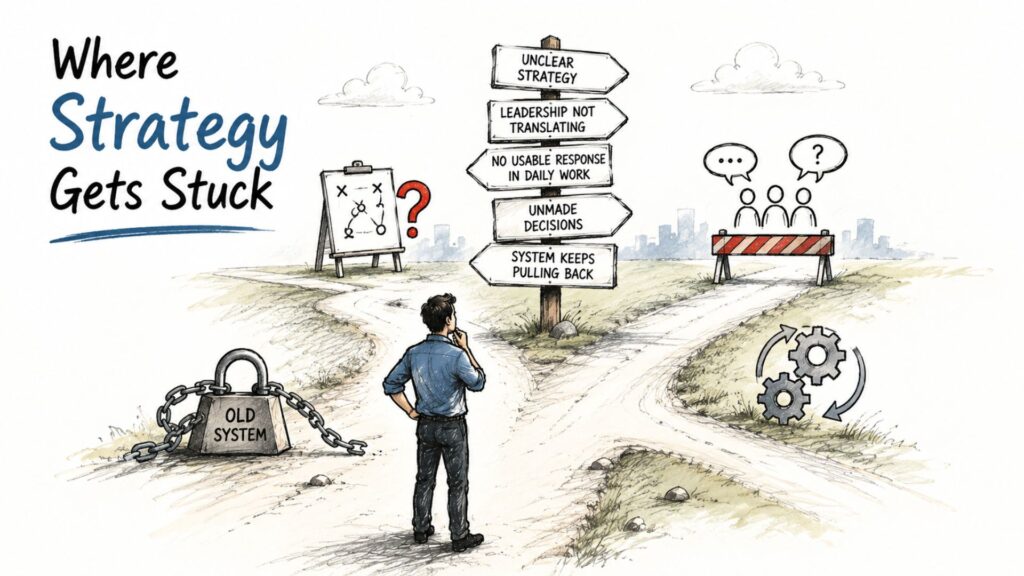
1. The strategy is not clear enough to guide a choice
A plan can contain goals, projects, scorecards, and priorities and still leave people uncertain about what matters most.
The problem usually becomes visible when priorities compete. A manager has two worthwhile projects but enough people for only one. A department receives three urgent requests from different executives. A team sees an attractive opportunity, but it is not obvious whether that opportunity belongs in the strategy.
At that moment, people need more than a statement they can repeat. They need a choice they can use.
Clear strategy helps people decide what receives attention, what gets funded, what waits, and what should be refused. If the strategy does not help people make those decisions, the problem may not be communication. The strategy itself may not yet be clear enough to guide the work.
If this is where your organization is stuck, begin with Make Strategy Clear.
2. Leaders understand the strategy, but daily leadership still produces the same work
Sometimes the strategy is reasonably clear. The blockage appears one level later.
Managers continue to make too many decisions themselves. Supervisors give assignments that require repeated clarification. Delegated work travels back upward when it becomes difficult. Meetings produce discussion, but not enough decisions, ownership, or follow-through.
In these situations, the strategy may have changed while leadership behavior stayed the same.
That matters because leaders do more than communicate strategy. They translate it into priorities, decisions, standards, assignments, meetings, coaching, delegation, and follow-through. People experience strategy through these daily moments.
So if the message is clear but leaders keep reproducing the conventional game, the strategy can remain trapped at the top.
If this sounds familiar, explore Build Leaders Who Move Work.
3. People know the priority, but they do not know what to do differently
Even when the strategy is clear and leaders support it, execution can still break down.
People may understand the priority and agree with it, but they do not have a practical response for the moment when it matters.
Consider a company that wants greater customer focus. Everyone may support the goal. But what should an employee do when a customer request conflicts with an internal rule? What should a supervisor do when speed and quality compete? What should a team do during a handoff when information is incomplete?
Broad instructions such as “take ownership,” “collaborate,” “move faster,” or “be customer-focused” often sound right but become weak under pressure because they do not tell people what to do in a recurring situation.
Execution becomes stronger when an important priority is translated into a practical response people can use, repeat, observe, and improve.
Strategic Learning calls these Minimum Lovable Plays: small enough to try, useful enough to repeat, and concrete enough to see in real work.
If people know what matters but the priority has not yet become a usable daily move, start with Make Execution Daily.
4. The work is stuck because an important choice has not been made
Sometimes the problem is not capability or behavior at all.
The work is stuck because leaders or teams have not resolved an important choice.
Two departments may be pulling in different directions. Leaders may agree on the destination but disagree on where to focus. A team may have several possible moves but no shared decision about which one deserves attention first.
People can keep working around this tension for weeks. The symptoms may look like poor coordination, slow execution, or weak accountability. But the real blockage is simpler: the organization has not made the choice that would allow the work to move.
This is where a Strategy Workshop can be useful. The purpose is not to gather people for another activity-filled day. The purpose is to bring the right people together, confront the real trade-off, make the decision visible, and design the first move.
The workshop is not the product.
The movement is.
If the work is waiting for a shared decision, explore Run Strategy Workshops That Move Work.
5. People learned the new response, but the system keeps pulling them back
Sometimes the organization has done almost everything right.
People attended the program. They understood the new behavior. They practised it. They may even have used it successfully for a while.
Then the old pattern returns.
That does not always mean people resisted the change or forgot the lesson. It may mean the surrounding work kept rewarding the familiar response.
Approval rules, measures, incentives, tools, information, manager signals, workloads, meeting rhythms, and decision rights all shape what people actually do. An organization can encourage initiative while requiring approval for small decisions. It can teach collaboration while rewarding departments only for their own targets. It can tell people to experiment while treating every failed attempt as poor performance.
People hear one message, but the working system teaches another.
When this happens, another workshop may not be the first answer. The organization may need to change the conditions around the behavior and follow proof into the work.
If this is where movement breaks down, explore Build Learning Systems and Proof.
Do not solve all five at once
An organization can have problems in more than one of these places. That is common.
But that does not mean you should launch five initiatives at the same time.
Find the blockage that matters most now.
Is the strategy itself unclear? Are leaders reproducing the same patterns? Do people lack a practical response? Is the work waiting for a decision? Or is the surrounding system pulling people backward?
Start with the place where movement is breaking down most visibly.
Then make one move and watch what happens.
The evidence may confirm that you found the right blockage. It may also show that the real problem sits somewhere else. That is not failure. That is learning.
Strategic Learning is learning how to make what matters happen.
We make strategy clear enough to guide choices. We make execution practical enough to enter daily work. We make impact visible enough to learn what deserves the next move.
If you are not yet sure which of these five places is holding your organization back, begin with the Strategic Learning pillar.
If you already recognize the problem and want help deciding what should move first, talk with Strategic Learning Consultants.