A clear strategy does more than describe the future. It helps people decide what deserves attention, what the organization will refuse, and what must change in daily work.
Your plan may contain everything except the choices people need
Your strategic plan may contain a mission, a vision, objectives, key results, projects, scorecards, and timelines. Leaders may have spent days discussing it. The final presentation may look complete.
Yet managers still ask which priority comes first. Teams continue protecting their own targets. New projects are approved without stopping existing work. When two reasonable options compete, people escalate the decision because the plan does not tell them which one serves the strategy.
The organization has a plan, but people cannot see the game it has chosen to play.
This creates a costly pattern. Leaders keep explaining the strategy, but every explanation adds more words. Managers interpret the priorities differently. Employees follow the work that is urgent, familiar, or requested by the person with the most authority.
The problem is not always poor communication. The strategy may not yet be clear enough to use.
By strategy, I mean a connected set of choices that gives what matters a usable direction. It tells an organization what it is trying to win, where it will focus, how it intends to win, what it must become capable of doing, and what it will not pursue with equal attention.
Those choices matter because resources are limited. Strategy helps people decide what deserves attention, what deserves investment, what should wait, and what should be refused.
A strategy becomes clear when people can see what matters most, what choices the organization has made, what it will not pursue, and what those choices change today.
When strategy becomes clear, people do not need senior leaders to resolve every conflict. They have a basis for judgment. They can direct resources, refuse distractions, and act within the chosen game.
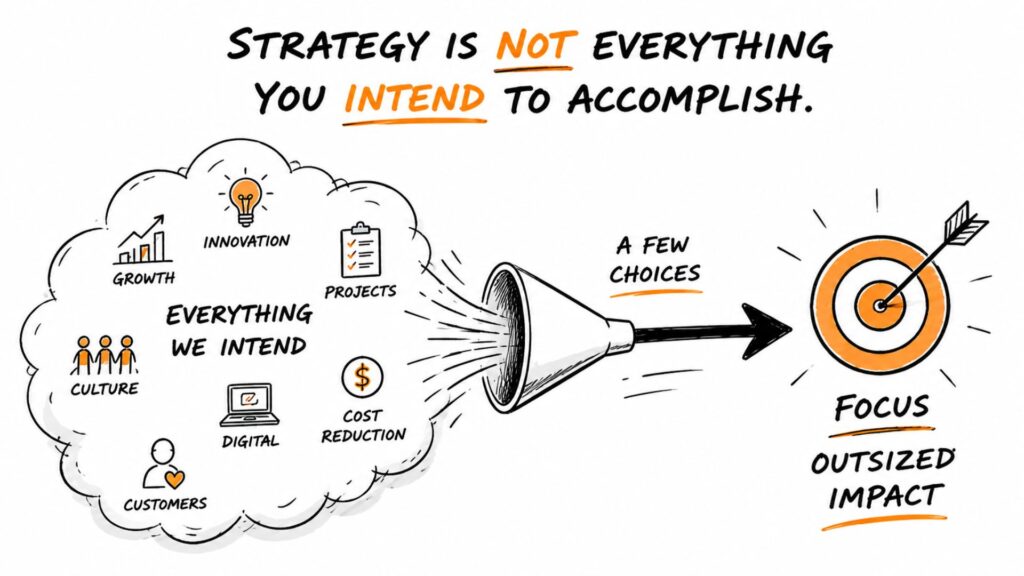
Strategy is not everything you intend to accomplish
Many strategic plans become crowded because leaders place every important concern inside them.
Growth matters. Customer experience matters. Innovation matters. Employee engagement matters. Efficiency, digital transformation, leadership development, sustainability, and operational excellence matter too.
The list may be accurate, but it does not create focus.
When everything is called strategic, each department can continue doing what it already does. Marketing protects growth. Operations protects efficiency. Human resources protects engagement. Finance protects cost. Everyone supports the plan, but the organization keeps playing several games at the same time.
A strategy is not a collection of worthy intentions.
A.G. Lafley and Roger Martin distinguish strategy from vision, detailed plans, optimization, and the imitation of industry practices. They present strategy as an integrated set of choices: what winning means, where the organization will play, how it will win, which capabilities it needs, and which management systems must sustain those choices.
The word integrated matters. The choices must reinforce one another.
An organization cannot claim to win through personal customer service while replacing every meaningful customer conversation with a rigid automated process. It cannot declare that decisions should move closer to the frontline while retaining approval authority at the top. It cannot pursue focus while continuing to fund every established initiative.
Strategy clarity begins when leaders stop asking, “What else should we include?” and begin asking, “What are we choosing?”
When your plan has become a collection of objectives, start by examining the crowded plan. You may discover that the organization does not need another priority. It needs to reveal the choices hiding beneath the list.
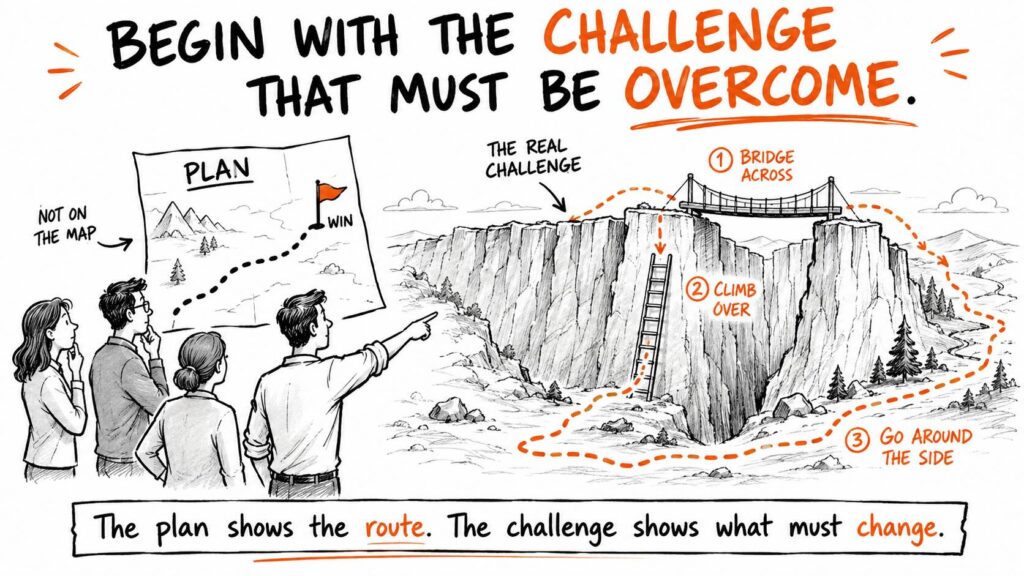
Begin with the challenge that must be overcome
Leaders sometimes begin strategy work by writing aspirations.
They want to become the market leader. They want profitable growth. They want customers to trust them, employees to thrive, and operations to become world-class.
These are desirable outcomes. They do not yet explain what stands between the organization and the future it wants.
Richard Rumelt argues that useful strategy begins by facing the challenge. His strategy kernel connects a diagnosis of the situation, a guiding policy for dealing with it, and coherent actions that carry that policy forward. He also warns against strategy made of slogans, ambitious goals, and long collections of objectives that never confront the central obstacle.
The diagnosis is not a description of everything that is wrong. It identifies the condition that matters most.
Perhaps the organization has many customers but no clear reason for those customers to choose it again. Perhaps growth has created complexity that slows decisions. Perhaps managers protect existing revenue while new competitors change what customers expect. Perhaps the company keeps introducing products while failing to build one capability that competitors cannot easily copy.
When the challenge remains vague, the strategy also becomes vague. Leaders add initiatives because they do not know where to concentrate action.
A useful diagnosis creates leverage. It helps leaders move from responding to many symptoms to confronting the condition that produces them.
This does not mean every problem disappears. It means leaders know which problem deserves coordinated attention now.
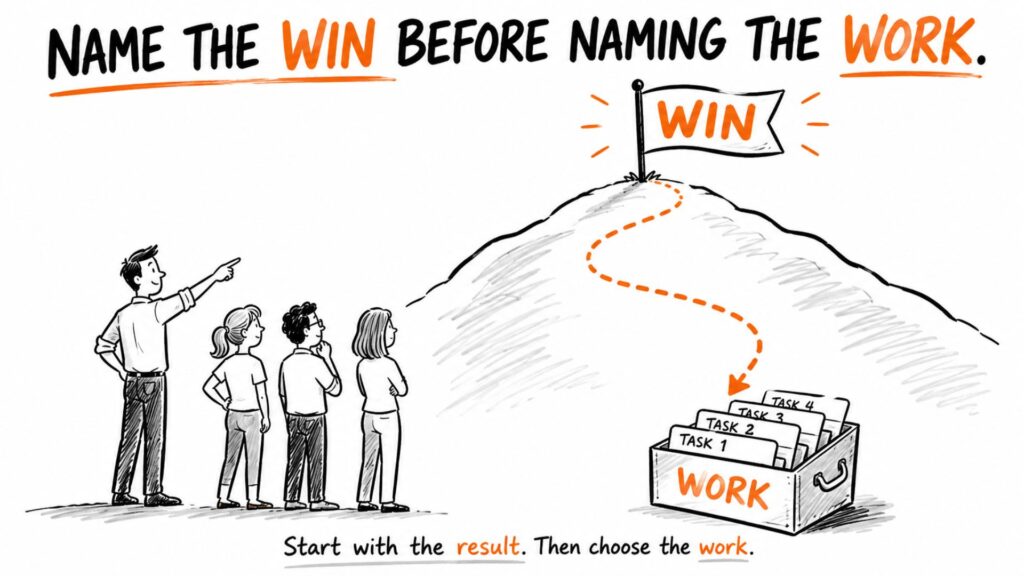
Name the win before naming the work
Once the challenge is clear, leaders need to define what winning means.
Without a clear win, strategy conversations move too quickly into activities. Teams propose campaigns, technology projects, training programs, restructures, and new policies. The plan becomes full before leaders have agreed on the result those activities should create.
“Grow the business” is not yet a clear win. Growth from whom, through what value, and with what consequence?
“Become customer-centric” is not yet a clear win. What should customers experience that they do not experience now?
“Build capable leaders” is not yet a clear win. What should leaders become able to move through their teams?
A useful win describes a future that can guide choices.
For example, an organization may decide that customers should receive complete resolution at the first responsible point rather than being passed across departments. That win changes decisions about authority, process design, measures, and capability.
A company may decide that its supervisors should move work through employee judgment rather than through constant checking and rescue. That win changes how supervisors delegate, coach, and review work.
The shift becomes visible. People can see what must stop and what must take its place.
Before adding projects, name the win. Mission and vision can then enter today’s choices instead of remaining statements people admire but cannot apply.
Choose where you will play
No organization can serve every customer, pursue every opportunity, and build every capability with the same level of commitment.
Where to play is therefore a strategic choice.
It may include the customers you will serve, the problems you will solve, the products or services you will offer, the locations you will enter, the channels you will use, or the part of the value chain where you will concentrate.
The choice also tells you where you will not play.
That second part is often avoided. Leaders fear that narrowing the field will close opportunities. They keep options open and describe the market broadly.
But a broad field does not preserve freedom. It scatters resources.
A training company that serves every audience with every topic competes as a general provider. A consultancy that chooses to help leaders turn strategy into daily behavior can build methods, products, evidence, and expertise around that specific challenge.
A financial institution may decide to serve growing family businesses that have outgrown basic banking but are not yet served well by large corporate systems. A healthcare provider may choose communities where integrated care can remove repeated transfers between disconnected services.
The value of the choice is not found in the words alone. It appears in the capabilities, offers, relationships, and resources the organization can now concentrate.
When the field remains broad, use choose the field to decide where the organization will focus its effort.
Explain how you intend to win there
Choosing a field does not explain why customers, partners, employees, or other stakeholders will choose you.
The organization also needs a clear view of how it will win.
This is not a slogan such as “through excellence,” “through innovation,” or “through our people.” Most organizations can make the same claim.
How to win describes the value you will create and the connected activities that allow you to create it.
A company may win by removing delays that competitors accept as normal. Another may provide expert judgment in a market filled with standard packages. Another may connect services that customers currently have to coordinate for themselves.
The choice must change the design of the organization.
If you intend to win through rapid local decisions, you need authority near the work, clear boundaries, accessible information, and leaders who do not take every decision back.
If you intend to win through deeply customized service, you need people who can diagnose needs, design responses, and maintain close customer relationships. A rigid high-volume system may contradict that choice.
If you intend to win through reliability, you need disciplined processes, visible handoffs, early detection of risk, and a response when performance moves outside agreed limits.
The question is not merely, “What do we promise?” It is, “What must we do differently and consistently for that promise to become credible?”
Continue with how to win when the chosen field is clear but the organization still lacks a distinct way to create value.
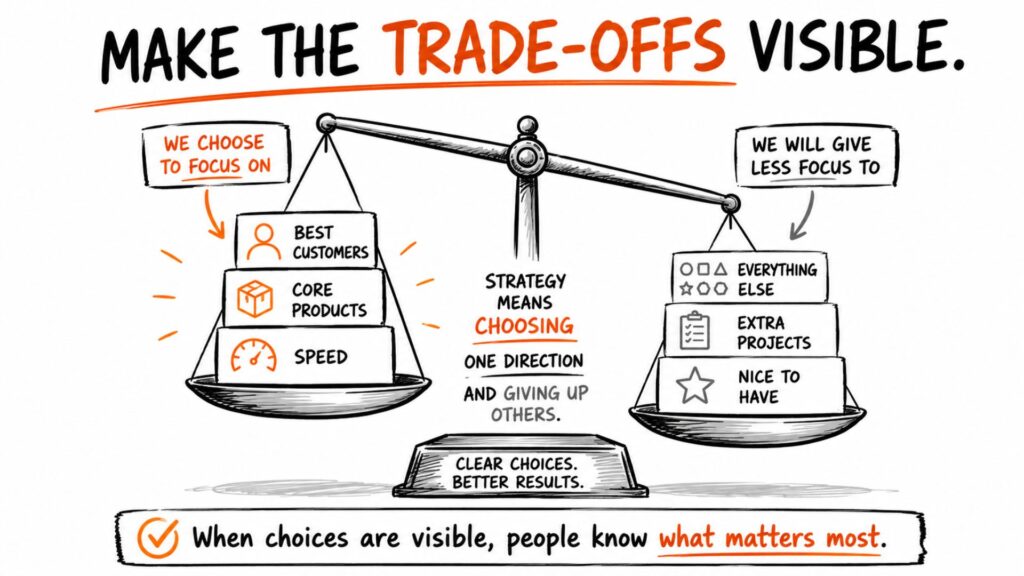
Make the trade-offs visible
A strategy becomes clearer when leaders explain what the organization will not do.
This is difficult because rejected opportunities are visible. The cost of scattered attention is not always as obvious.
A proposed project may promise new revenue. An established program may have powerful supporters. A customer segment outside the chosen field may still appear attractive. Leaders can find a reasonable argument for keeping each one.
But every additional commitment consumes money, time, management attention, and operational capacity.
When leaders refuse to make the trade-off, managers make it privately. Work is delayed without explanation. Teams spread people across too many projects. Employees learn that every priority is permanent, so they wait to see which one senior leaders will mention next.
The shift needed is from adding every defensible initiative to protecting the choices that define the strategy.
Trade-offs do not always mean permanent rejection. Some opportunities may be placed in “not now.” But the timing must be real. The organization cannot treat postponed work as an active priority with fewer resources.
Use visible trade-offs to show what receives concentration, what receives maintenance, and what will stop. Then examine whether all items called priorities are truly strategic priorities.
Focus becomes credible when something loses attention.
Build the capabilities the strategy depends on
A strategy may make sense on paper and still fail because the organization cannot perform the activities the choice requires.
A business that chooses rapid customization may lack people who can diagnose customer needs. A company that promises seamless service may operate through departments that rarely share information. An organization that wants decisions near the customer may have supervisors trained to enforce compliance rather than develop judgment.
These are not side issues. They are part of the strategy.
Leaders must ask what the organization must become able to do repeatedly.
This requires more than listing broad competencies. “Communication,” “innovation,” and “leadership” remain too open. The capability must be connected to the chosen game.
For example, leaders may need to become able to turn a strategic priority into clear decision boundaries. Supervisors may need to shift from issuing detailed instructions to delegating a win. Teams may need to manage a customer concern across departmental handoffs without losing ownership.
Michael Watkins describes strategic thinking as a set of disciplines that helps leaders recognize threats and opportunities, understand systems, establish priorities, solve complex problems, envision possible futures, and mobilize people toward a path forward. These disciplines matter because leaders must interpret changing conditions without losing the choices that give the organization direction.
The leader behavior pillar examines how leaders carry strategy through decisions, direction, delegation, meetings, coaching, and follow-through.
A strategy becomes clear to the organization when leaders express it through the way they lead the work.
Give people a game plan they can use
A strategy does not need to fit into one sentence, but people should be able to see its logic without opening a hundred-page document.
They need to understand the challenge, the win, the chosen field, the way the organization intends to win, the capabilities required, and the systems that will keep the choices alive.
A one-page game plan can make this logic visible.
The purpose of the page is not to compress every analysis. It is to show how the choices connect.
A useful game plan helps people answer practical questions. Does this opportunity belong in our chosen field? Does this project build a capability the strategy requires? Does this decision reinforce our way to win? What should receive less attention because of this choice?
This is different from creating a summary poster filled with inspiring phrases. A poster reminds people of the language. A game plan helps them judge the next move.
Build a one-page game plan when the strategy exists across several documents but its central logic remains difficult to see.
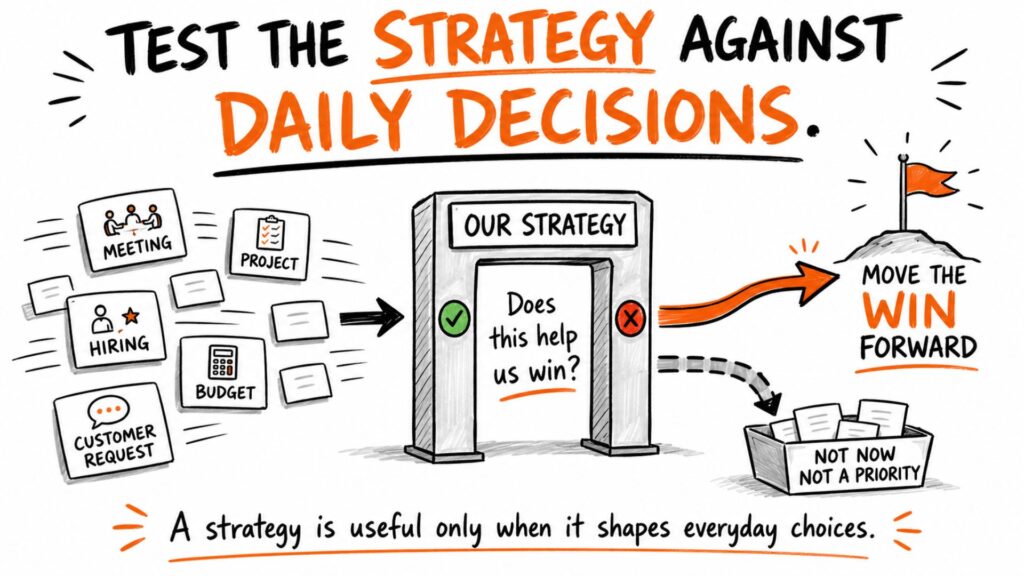
Test the strategy against daily decisions
Leaders may believe the strategy is clear because they participated in creating it. They know the debates, assumptions, and compromises behind the final words.
Other people see only the finished document.
The real test comes when someone must make a decision.
Should the company accept a customer outside the chosen market? Should a team automate the process or preserve personal judgment? Should a manager approve an initiative that promises revenue but consumes a capability required by the strategic bet?
If different leaders give conflicting answers, the strategy may still contain unresolved choices.
A decision test brings the strategy into use. It asks people to apply the choices to situations that could realistically happen.
A useful test may include five questions:
- What win does this decision serve?
- Does it belong in our chosen field?
- Does it reinforce how we intend to win?
- What will receive less because we choose this?
- What evidence will tell us whether the decision worked?
The questions belong together. A decision may serve the aspiration but sit outside the chosen field. It may promise growth while weakening the organization’s distinct way of creating value. It may fit the strategy but require a trade-off leaders are unwilling to make.
Use a decision test before declaring that the strategy is ready to cascade.
Turn the strategy into a first bet
Clarity does not mean certainty.
Leaders cannot know everything before acting. Customers may respond differently than expected. Competitors may change. A capability that appears sufficient may fail under pressure.
But uncertainty should not send the organization back to vague language.
A clear strategy identifies the assumptions that matter and turns them into a practical bet.
Suppose leaders believe that a selected group of customers will choose them because they can remove a delay that competitors have accepted. The first bet should test that claim. It should place a real offer in front of real customers and produce evidence soon enough to guide the next move.
The strategy remains a choice. The bet helps leaders learn whether the choice can produce the intended result.
This is where clarity connects with daily execution. The organization must move from strategic logic to a play, an owner, a rhythm, and proof.
Choose a first strategic bet rather than launching every initiative in the plan. Then follow the proof before adding more work.
The shift is from funding a complete plan based on confidence to investing in a chosen direction while learning from evidence.
Keep the management system aligned with the choices
Even a clearly expressed strategy can disappear inside the operating system.
The organization may choose focus, but the budget continues spreading funds across old priorities. It may choose ownership, but approval rules keep decisions at the top. It may choose customer resolution, but performance measures reward departments for transferring work quickly.
The system reveals which strategy people are expected to follow.
This is why management systems are not added after the strategy. They are part of it.
Meetings must give attention to the chosen bets. Measures must reveal whether the strategy is moving. Resource decisions must protect the capabilities that matter. Leaders must stop rewarding behavior that belongs to the old game.
The learning systems pillar shows how practice, manager support, routines, and visible proof help the strategy survive beyond the planning session.
Clarity is not created once. It is reinforced whenever the system gives people the same message as the strategic choices.
Play to Win Strategy turns a crowded plan into connected choices
Some organizations need more than another planning workshop. They need a disciplined way to confront the challenge, make the choices, and turn those choices into a game people can play.
Play to Win Strategy helps leadership teams move from a plan filled with priorities to a connected set of choices. The work clarifies the win, where the organization will play, how it intends to win, the capabilities the choice requires, and the systems that must keep the strategy alive.
The result is not a thicker plan.
It is a usable game plan, a first set of strategic moves, and a rhythm for following proof.
That distinction matters. A planning activity can end with agreement. A strategy process must change how the organization chooses, invests, leads, and acts.
Begin with the choice people cannot make today
You do not need to rewrite the entire strategic plan before making progress.
Begin with one decision people repeatedly escalate or resolve inconsistently.
Ask why the plan does not help them choose. Is the win unclear? Is the field too broad? Is the way to win generic? Has the trade-off been avoided? Does the operating system reward the opposite choice?
Then name the contrast.
What does the organization do now? What should it do instead because of the strategy?
Perhaps leaders must shift from funding every reasonable project to protecting one strategic bet.
Perhaps managers must shift from asking whether a request is useful to asking whether it belongs in the chosen field.
Perhaps teams must shift from completing departmental activity to owning the result the customer experiences.
When the contrast becomes visible, the strategy begins to guide action.
That is the purpose of making strategy clear. It is not to make strategy easy, remove uncertainty, or reduce it to a slogan.
It is to help people see the game, understand the choices, and know what those choices require today.
Return to the main Strategic Learning hub to see how clear strategy connects with daily behavior, practical plays, working systems, and visible impact.
Recommended reading
A.G. Lafley and Roger L. Martin, Playing to Win: How Strategy Really Works. The book presents strategy as an integrated cascade of choices about winning, where to play, how to win, required capabilities, and management systems.
Richard P. Rumelt, Good Strategy/Bad Strategy. Rumelt distinguishes strategy from goals and slogans, then explains how diagnosis, guiding policy, and coherent action concentrate effort on the central challenge.
Michael D. Watkins, The Six Disciplines of Strategic Thinking. Watkins examines pattern recognition, systems analysis, mental agility, structured problem-solving, visioning, and political savvy as disciplines leaders use to interpret uncertainty and mobilize action.

About Jef Menguin
Jef Menguin is a leadership development consultant, motivational speaker, and creator of the Strategy Workshop Playbook. He helps organizations turn strategy into practical plays, daily leadership behaviors, and visible results.
Explore Strategic Learning’s leadership training programs, learn more about Jef as a motivational speaker in the Philippines, or connect with him on LinkedIn.